Why Fuel Properties Require Specialized Environmental Due Diligence
Commercial fueling stations, bulk petroleum terminals, fleet depots, and former auto service facilities carry elevated subsurface risk compared to standard retail real estate. Decades of underground storage tank (UST) operations, product piping transfers, and dispenser island spills can leave behind latent hydrocarbon plumes long after old tanks have been upgraded or removed.
Before closing on a property acquisition, SBA 504/7(a) loan, construction refinance, or brownfield redevelopment in Texas, commercial lenders and buyers rely on phased Environmental Site Assessments (ESAs) to satisfy the EPA's All Appropriate Inquiries (AAI) rule (40 CFR Part 312) and secure CERCLA Innocent Landowner liability protection.
Phase I ESA (ASTM E1527-21): Non-Intrusive Liability Screening
A Phase I ESA evaluates historical and current operations without drilling or physical sampling. Under the current ASTM E1527-21 standard, a qualified Environmental Professional conducts four core components:
- Historical Records Review: Sanborn fire insurance maps, historical aerial photographs, city directories, and chain-of-title environmental liens back to 1940 or first developed use—critical for spotting unregistered "ghost tanks."
- Regulatory Database Audit: Federal EPA and state TCEQ Leaking Petroleum Storage Tank (LPST) registries, UST registration logs, dry cleaner remediation databases, and vapor encroachment screening within statutory search radii.
- Site Reconnaissance: Visual inspection of fill ports, observation wells, vent risers, oil-water separators, stained concrete, stressed vegetation, and adjacent up-gradient properties.
- Interviews & Classification: Structured interviews with current owners, site managers, and municipal officials to classify findings into Recognized Environmental Conditions (RECs), Controlled RECs (CRECs), or Historical RECs (HRECs).
When Does a Phase I Trigger a Phase II ESA (ASTM E1903)?
For active or historical gas stations in Houston and across Texas, a Phase I ESA frequently identifies at least one REC—such as legacy single-wall piping, an undocumented tank pit, or a historical release lacking modern TCEQ closure documentation. A REC does not automatically kill a deal; rather, it signals the need for quantitative verification through a Phase II ESA.
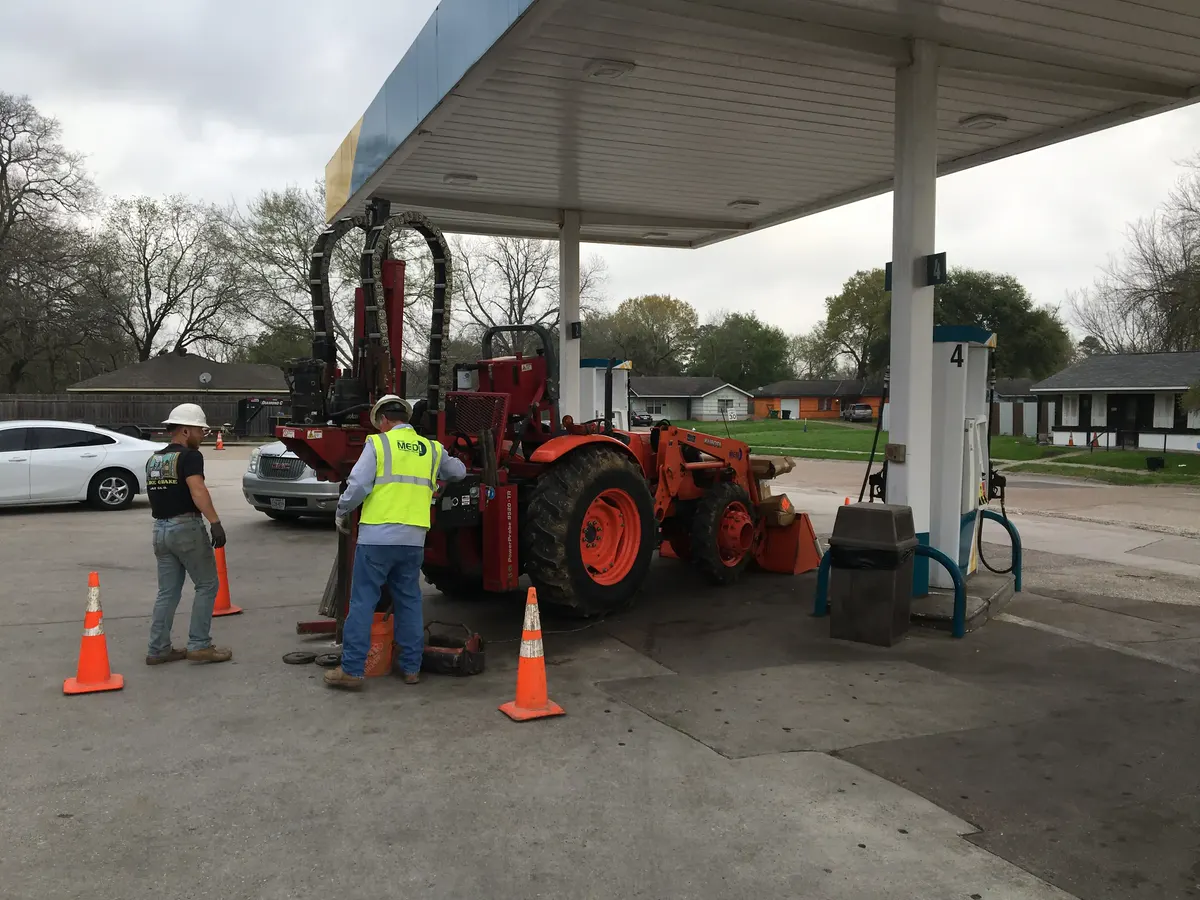
- Direct-Push Geoprobe® Soil Borings: Advancing targeted borings around tank holds, product lines, and dispenser islands to screen vadose-zone soils with a photoionization detector (PID).
- Temporary Groundwater Monitoring Wells: Evaluating shallow perched groundwater—especially critical across Houston's high water table and Gulf Coast clay-sand stratigraphy.
- Sub-Slab Soil Vapor Sampling: Assessing volatile organic compound (VOC) vapor intrusion risk beneath C-store buildings or proposed commercial structures.
- Accredited Laboratory Analysis: NELAP-accredited testing for BTEX (benzene, toluene, ethylbenzene, xylenes), MTBE, polycyclic aromatic hydrocarbons (PAHs), and Total Petroleum Hydrocarbons (TPH) under TCEQ Texas Risk Reduction Program (TRRP, 30 TAC Chapter 350) protective concentration levels (PCLs).
Turning Environmental Data into Deal Certainty
When laboratory results fall below TCEQ Residential or Commercial/Industrial Tier 1 PCLs, buyers and lenders gain documented confidence to close. When exceedances are discovered, quantified plume boundaries allow buyers to negotiate escrow holdbacks, price adjustments, or enroll eligible sites into regulatory corrective action programs before assuming title.
Need rapid turnaround for an upcoming closing date? Geo Petroleum's Houston due diligence specialists deliver lender-ready Phase I and Phase II Environmental Risk Assessments engineered specifically for Texas petroleum and industrial assets.